
In Vitro Fertilization (IVF)
Advanced Fertility Care
In Vitro Fertilization (IVF): A Trusted Path to Parenthood
In vitro fertilization (IVF) is a proven and effective fertility treatment that helps individuals and couples achieve pregnancy when natural conception is difficult. It may also be used to reduce the risk of passing certain genetic conditions to a baby.
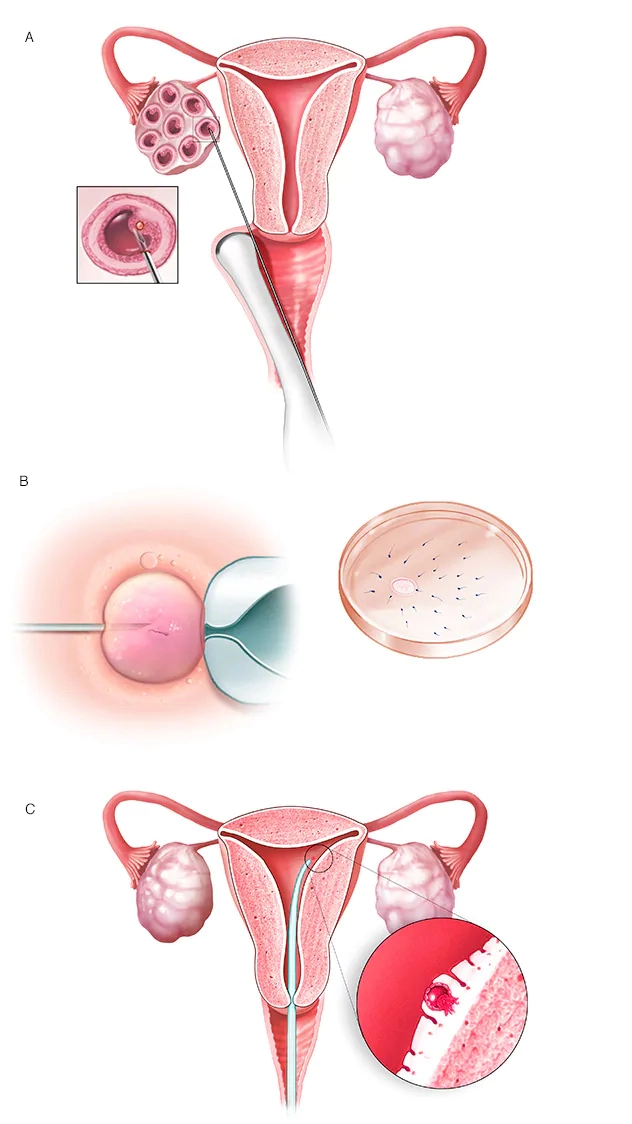
During IVF, healthy eggs are gently collected from the ovaries and fertilized with sperm in a specialized laboratory. Once fertilization occurs, the best-quality embryo is carefully transferred into the uterus, where pregnancy can begin. A typical IVF cycle takes about 2–3 weeks, although some patients may require a longer or staged approach depending on their medical needs.
IVF is the most successful form of assisted reproductive technology (ART). It can be performed using your own eggs and sperm, or with donor eggs, sperm, or embryos when needed. In some situations, a gestational carrier (surrogate) may carry the pregnancy.
Success rates with IVF depend on several factors, including age, overall health, and the underlying cause of infertility. While IVF is a highly advanced treatment, it can involve emotional, physical, and financial considerations. Your fertility specialist will guide you on the safest approach, including minimizing the risk of multiple pregnancies.
If you are considering IVF, our experienced fertility team is here to support you at every step—answering your questions, explaining your options, and creating a personalized treatment plan to help you move confidently toward parenthood.
IVF Treatment Guide
Why IVF Is Done, What to Expect, and Is It Right for You?
In Vitro Fertilization (IVF) is an advanced fertility treatment that helps individuals and couples conceive when natural or simpler treatments haven’t worked—or aren’t suitable. In IVF, eggs are fertilized with sperm in a laboratory, and the healthiest embryo(s) are then transferred to the uterus.
IVF may be recommended after trying less-invasive options such as fertility medications or intrauterine insemination (IUI). In some cases—especially for women over 40 or those with specific medical conditions—IVF may be advised as the first-line treatment.
IVF may be a suitable option if you or your partner has:
- Blocked or damaged fallopian tubes - Prevents the egg and sperm from meeting naturally
- Ovulation disorders – Irregular or absent ovulation limits egg availability
- Endometriosis – Can affect ovarian function and tubal health
- Uterine fibroids – May interfere with embryo implantation
- Previous tubal ligation – IVF avoids the need for reversal surgery
- Male factor infertility – Low sperm count, poor motility, or abnormal shape
- Unexplained infertility – No clear cause despite thorough evaluation
- Genetic conditions – IVF with genetic testing helps reduce the risk of passing on inherited disorders
- Fertility preservation needs – Before cancer treatments like chemotherapy or radiation
- Medical conditions making pregnancy unsafe – IVF with a gestational carrier may be considered .
IVF is generally safe, but like all medical treatments, it has potential risks, including:
- Multiple pregnancies (if more than one embryo is transferred)
- Preterm birth or low birth weight
- Ovarian hyperstimulation syndrome (OHSS)
- Miscarriage (risk increases with age)
- Ectopic pregnancy
- Rare complications from egg retrieval or anesthesia
- Emotional, physical, and financial stress.
Before starting IVF, you and your partner may undergo:
- Hormone tests & ovarian reserve testing
- Ultrasound of ovaries and uterus
- Semen analysis
- Infectious disease screening
- Mock embryo transfer or uterine evaluation
Your doctor will also discuss costs, success rates, number of embryos to transfer, and options for unused embryos.
IVF typically takes 2–3 weeks per cycle and includes:
- Ovarian stimulation – Medications help produce multiple eggs
- Egg retrieval – Eggs are collected under sedation
- Sperm collection & fertilization – Eggs are fertilized using standard IVF or ICSI
- Embryo development & testing (if needed)
- Embryo transfer – One or more embryos are placed into the uterus
A pregnancy test is done about 12–14 days after egg retrieval.
IVF success depends on several factors, including:
- Age of the woman
- Egg and embryo quality
- Cause of infertility
- Previous pregnancy history
- Lifestyle factors (smoking, weight, alcohol, stress)
Your doctor will personalize your treatment to maximize success.
If you’re struggling to conceive or exploring advanced fertility options, IVF may offer hope and real possibilities. A detailed consultation with a fertility specialist can help you understand your options and choose the right path forward.