
Natural Birthing
Empowered Birth Choices
Understanding Natural Birth: What It Means and What’s Right for You
Whether you choose to welcome your baby at home, in a birthing center, or in a hospital—or plan for a vaginal delivery or a C-section—every birth is natural. What matters most is a safe delivery and a healthy mother and baby. There is no single “right” way to give birth, and every woman’s journey is powerful in its own way.
Traditionally, the term natural birth has been used to describe childbirth without the use of pain-relief medications. For some women, this may still include certain medical supports, such as fetal heart monitoring, while for others it may involve minimal or no medical interventions at all.
In natural childbirth, pain is often managed through breathing techniques, relaxation methods, movement, and emotional support rather than medications. Many women find these approaches empowering and deeply personal.
Although natural birth is often associated with home births, midwives, or doulas, it can also take place safely in a hospital setting with the right guidance and support.
At the heart of every birth plan is your choice. Our role is to support you with expert guidance, compassionate care, and clear information—so you can make confident decisions that align with your body, your comfort, and your vision for childbirth.
Informed Choices for a Confident Birth
A natural delivery is not about enduring pain—it is about informed choice, preparation, and personalized care.
Choosing how you give birth is a deeply personal decision. A “natural” delivery—meaning childbirth without routine pain medication—can be an empowering and rewarding experience for many women. While it may sound challenging at first, understanding the benefits, expectations, and options can help you decide what best supports you and your baby.
It is important to be realistic—labor involves pain, and the intensity varies widely from woman to woman. Even if you have delivered before, each labor can feel different.
All births, whether medicated or unmedicated, carry potential risks such as heavy bleeding or umbilical cord issues. In some cases, these complications may require medical intervention. For this reason, flexibility is key. Even with a natural birth plan, procedures such as assisted delivery or a cesarean section may become necessary for the safety of the mother or baby.
Women with low-risk pregnancies are generally the best candidates for a natural delivery, under the guidance of an experienced healthcare provider.
Preparation is essential. Having a clear birth plan and discussing it with your doctor, midwife, or support team helps ensure everyone understands your preferences.
Childbirth education classes can be very helpful, teaching you what to expect during labor and how to manage pain naturally. Practicing these techniques ahead of time allows you to discover what works best for your body and mindset.
Recovery after a natural delivery is similar to any vaginal birth. Many women feel much better within six to eight weeks, though recovery timelines vary.
You may experience soreness for a few days. Simple measures such as rest, ice packs, and sitz baths can provide relief. Most importantly, give yourself time to heal and focus on your well-being as you adjust to life with your newborn.
Many women opt for a natural birth because they want a more active role in their labor and delivery. Avoiding pain medication may help labor progress more naturally, as some medications can slow contractions or cause side effects such as nausea or low blood pressure.
Others feel that a natural delivery allows them to stay more present, connected, and aware during childbirth—helping them fully experience and remember the moment their baby is born. For some, it also supports early bonding and breastfeeding immediately after delivery.
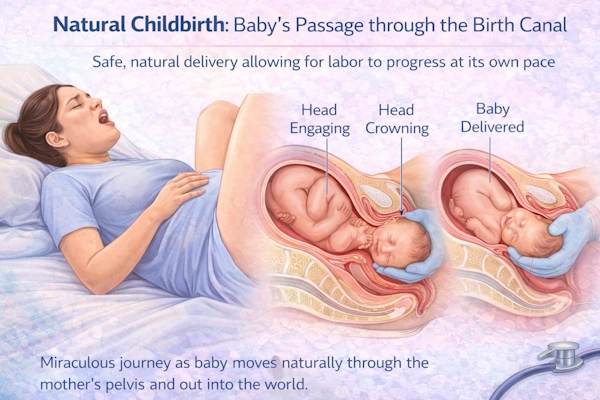
In a natural delivery, labor begins on its own and progresses without medication unless medically required. If you deliver in a hospital or birthing center, your doctor or midwife will monitor you and your baby—either continuously or at regular intervals—based on your preferences and clinical needs.
When it is time to give birth, you are free to choose a position that feels most comfortable for you. Medical interventions are used only if they are necessary for your or your baby’s well-being.
Because labor progresses naturally, it may take longer—especially for first-time mothers. However, it is worth noting that certain pain medications, such as epidurals, can also slow labor in some cases.
Pain levels differ for every woman. Many natural pain management techniques—such as breathing exercises, movement, massage, water therapy, and relaxation methods—can help you cope effectively.
After birth, most mothers are able to hold their baby immediately and begin breastfeeding as soon as they feel ready, supporting early bonding.
Changing your mind during labor is completely okay. Birth rarely follows a script, and your comfort and safety come first. If labor pain becomes overwhelming, pain relief options are usually available as long as delivery has not already begun.
Options may include epidurals, spinal blocks, or other forms of pain relief. These methods can significantly reduce pain while allowing you to remain awake and alert. Your care team will guide you through the safest and most appropriate choice based on your stage of labor.
What We Offer
Complete Women’s Healthcare Services
A full spectrum of gynaecologic and maternity services delivered with clinical precision and personalized attention.
Maternity Care
Comprehensive antenatal, delivery, and postnatal care focused on the health of both mother and baby.
Womanhood Care
Personalized gynaecologic care supporting hormonal, menstrual, and reproductive health at every life stage.
Invasive Surgeries
Advanced surgical procedures designed for precision, safety, and faster recovery.
Dedicated to Providing Quality Healthcare for All, Every Day
With the support of an experienced Dr. Sakshi Goel, many women with high-risk pregnancies go on to have safe and healthy deliveries.